Irrigation Engineering & Water Management
Irrigation design and engineering for commercial farms, orchards and greenhouses, and turnkey irrigation and field irrigation projects: AGIMEX carries crop-led hydraulic design and system specification and, within the agreed scope, procurement and supply, fertigation, automation, installation, testing and commissioning. AGIMEX does not manufacture irrigation equipment.
Field application
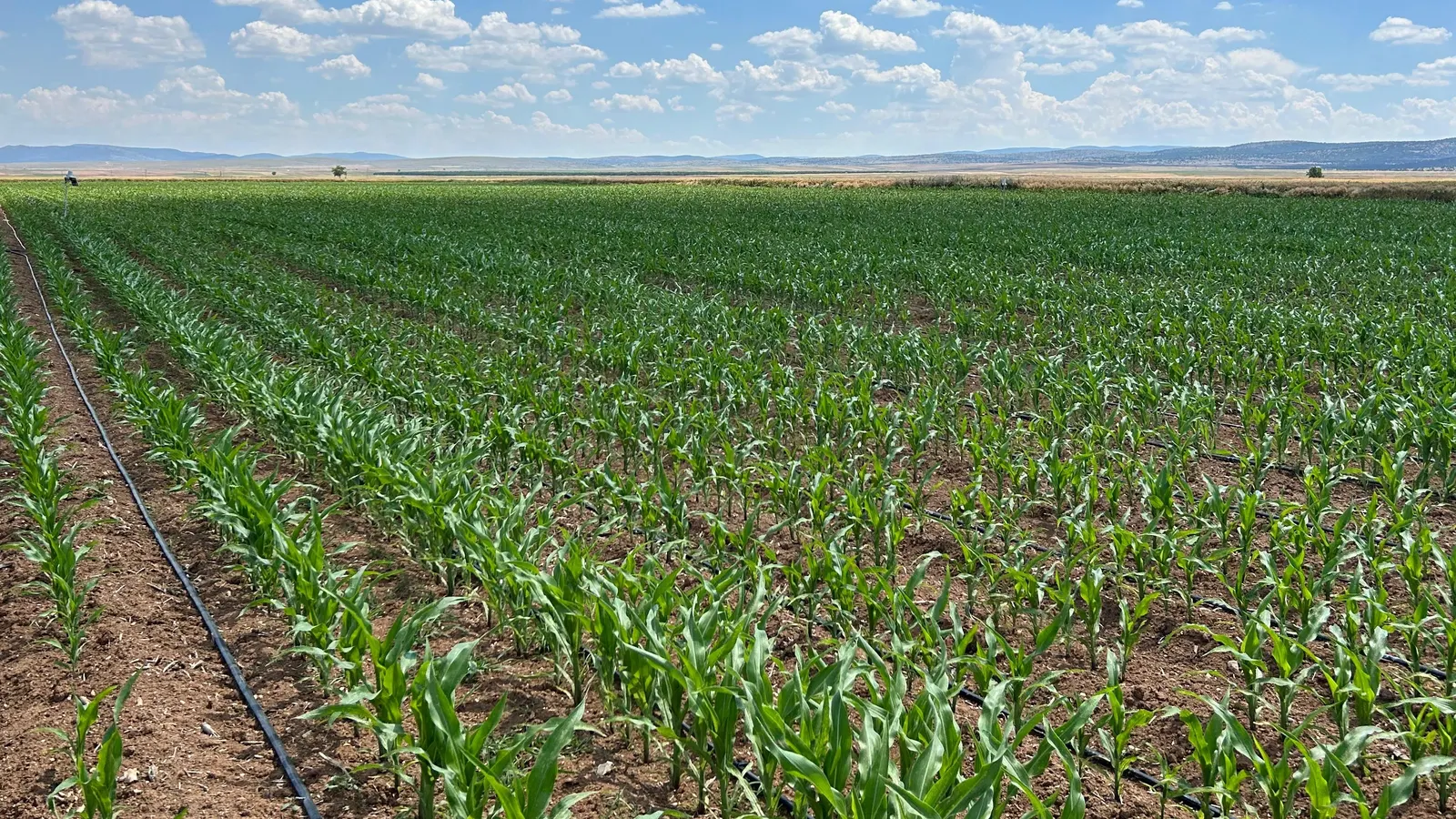
The system starts with the crop, not the catalogue
An irrigation system is a way of meeting a crop's water requirement under a specific set of site constraints. It is designed, not selected. The inputs that determine it are the crop and its growth stages, soil texture and depth, climate, the water available and its quality, topography, parcel geometry, energy supply and how the operation intends to work. Equipment appears at the end of that chain. Reversing the order produces systems that are defensible on paper and unworkable in the field. AGIMEX undertakes turnkey irrigation and field irrigation projects, including orchard irrigation, where the scope can run from survey inputs and hydraulic design through product selection, supply, filtration, fertigation, pumping interfaces, automation, field installation, testing and commissioning. AGIMEX does not manufacture irrigation equipment.
From requirement to observed behaviour
Design runs in one direction. Production requirements and physical conditions establish what the irrigation system must do; that required behaviour becomes hydraulic and agronomic criteria; the criteria produce a system architecture; the architecture determines what has to be measured to know whether the system is doing it. Reversing this — starting from equipment and working back toward a justification — produces designs that are internally consistent and wrong at the first constraint the site imposes. For on-farm irrigation the same sequence runs from preliminary design to detailed design, and an existing design can be reviewed against the same criteria before anything is procured.
Water availability and water quality set the boundaries
Source capacity is not a single number. Usable flow depends on seasonal behaviour, well recovery, abstraction rights, power availability and the hours per day the system can realistically run. Water quality determines filtration, emitter choice, chemical management and maintenance load: suspended solids, carbonates, iron, manganese and biological activity each fail a system in a different way. A water analysis and an honest statement of source behaviour are worth more at the start of a project than any amount of equipment discussion.
Crop water requirement and the operating window
Peak demand, not average demand, sizes the system. Reference evapotranspiration adjusted by crop coefficient gives the requirement through the season; the operating window — how many hours a day water can actually be delivered — converts that into required instantaneous flow. The same hectarage needs a materially different system where twelve hours a day are available than where six are, and that single constraint often decides the block architecture.
Hydraulic design determines whether the design works
Pipe sizing, friction loss, elevation change, pressure regulation and emitter operating range have to be resolved together across mainline, submain, manifold and lateral. Distribution uniformity is established here and cannot be recovered afterwards by operating the system differently. A design that ignores elevation on sloping ground, or that sizes laterals for average rather than worst-case position, produces fields where the far end is chronically under-watered while the near end is over-watered.
Hydraulics & zoning
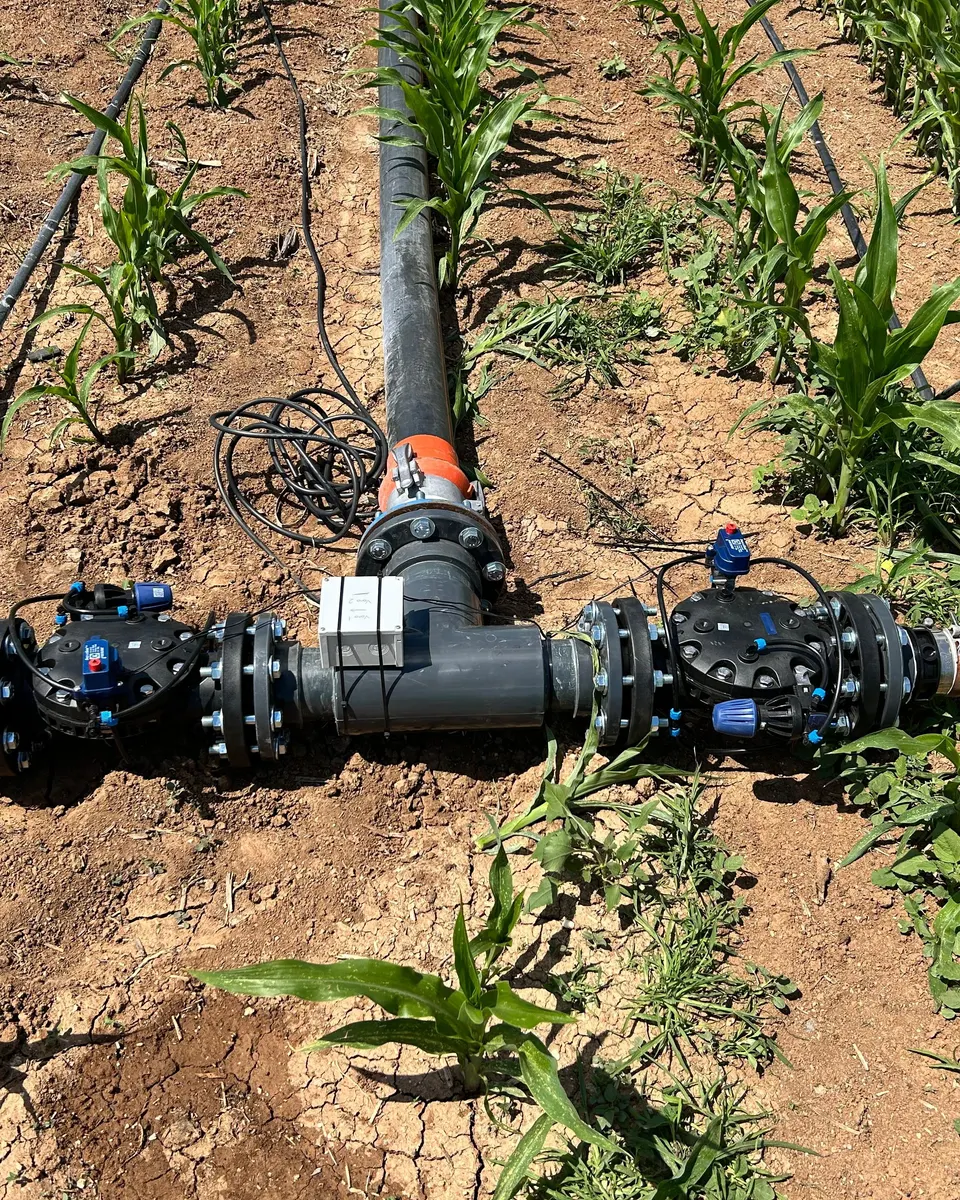
Block architecture, zoning and simultaneity
How the area is divided into blocks, how many operate simultaneously and how the rotation is sequenced follow from available flow, pressure, crop grouping, soil variability and the operating window. Zoning decisions also determine how finely the operation can differentiate irrigation later: blocks drawn only for hydraulic convenience remove agronomic control that cannot be added back without rebuilding the network. Where future expansion is planned, the mainline, headworks and control architecture are sized for it or given reserved capacity at design stage, because extending an under-sized network later usually means rebuilding it.
Pumping, storage and energy
Pump selection follows from the duty point the network requires across its operating range, not from a nominal figure. Where demand and source capacity do not coincide, storage reconciles them. Energy is frequently the limiting factor rather than water: tariff structure, connection capacity, interruption frequency and the option of variable-speed control all change what the system should be. A hydraulically sound design that the operation cannot afford to run is not a sound design.
Filtration matched to the source
Filtration is selected against water quality and the emitter's sensitivity, not by default. Screen, disc, media and hydrocyclone stages address different contaminants, and the backflush regime has to be designed with the water and energy it consumes. Under-specified filtration shows up as clogged emitters and lost uniformity months later, in a form that is usually blamed on the emitter.
Fertigation as a designed subsystem
Fertigation is part of the hydraulic and agronomic design, not an accessory. Injection method, capacity, compatibility and sequencing, mixing and dilution, backflow protection, and the interaction between nutrient solution chemistry and the source water all have to be resolved. Where fertigation is added to a network designed without it, the usual symptoms are uneven nutrient distribution and accelerated emitter fouling.
Fertigation
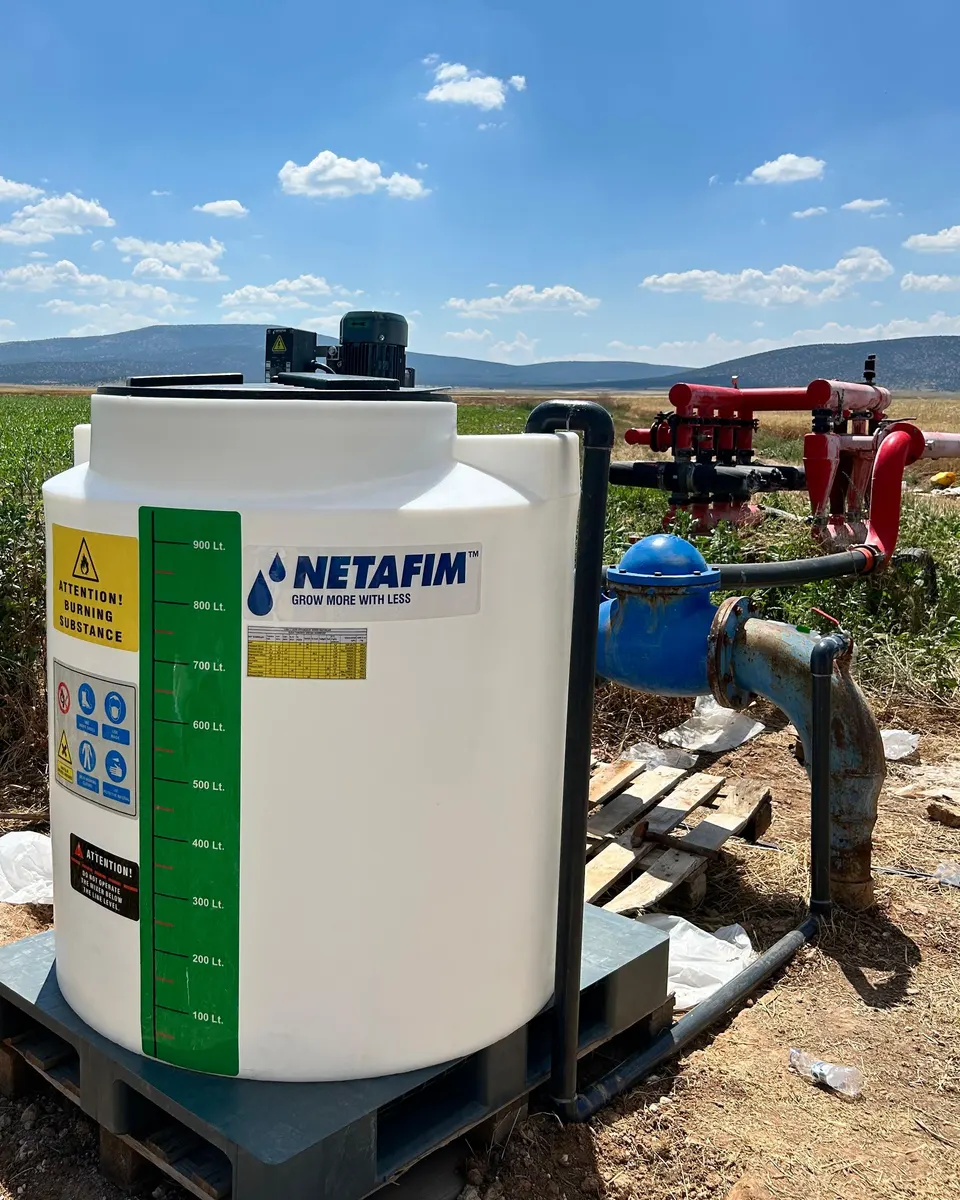
Three layers, not one equipment chain
It is useful to read an irrigation system as three layers that answer different questions. Design inputs — crop, soil, climate, terrain, water availability and quality, operating requirements — decide what the system has to be. The engineered physical system, from source through pumping, filtration, fertigation, distribution and zoning to the application method, is what meets that. Control and observability — automation, flow and pressure measurement, soil measurement, alarms and analysis — make its actual behaviour visible. Depending on the project, any layer may be light or absent; a design-stage scope may never reach the third.
Method selection: drip, subsurface, sprinkler, pivot
The method follows the crop, soil, topography, water quality, mechanisation requirement and operating capacity. Surface drip and micro-irrigation suit most permanent crops and many row crops; subsurface drip can be the right answer for field crops where it is compatible with cultivation practice, rodent pressure and maintenance capability; sprinkler and pivot remain appropriate for particular crops and geometries. The same crop can justify different methods on different sites, and the decision belongs after the water budget, not before it.
Automation, instrumentation and operation
Automation is worth installing when it changes how the system is operated. Valve sequencing, flow and pressure monitoring, filtration backflush control and fault alarms make the network observable; soil and plant measurement inform when and how much to irrigate. Instrumentation should be placed so that a reading identifies which part of the system is behaving unexpectedly. Control that only opens and closes valves on a timer replaces one fixed schedule with another. Operational resilience belongs to the same design: what the system does on a power interruption, a failed valve or a lost signal, and how it can be run manually, is decided before commissioning.
Automation architecture
Irrigation blocks are served by distributed field control units. Control cable routes connect the units to two water and fertigation centres, each combining pumping, filtration, fertigation and the central controller. A mounting detail shows the field unit on a post with its cable entry and valve connection.
- Pumping
- Filtration
- Fertigation
- Controller
- Pumping
- Filtration
- Fertigation
- Controller
Field control unit — mounting detail
- Enclosure on post
- Protected cable entry
- Valve solenoid connection
- Field control unit
- Control cable route
- Irrigation block
Schematic; not to scale and not a site layout.
Modernising an existing system
Modernisation begins with measurement, not with a proposal. What does the system actually deliver in pressure and flow, where does uniformity break down, what does the fault history show, which components are at end of life and which are simply mis-specified? That review determines what is replaced, what is retained and what only needs to be operated differently. Savings depend on the baseline and the operating conditions, so any figure quoted before the baseline is measured is a guess.
Information to get started
- Source capacity and water analysis
- Topography and soil information
- Existing equipment and operating records
Potential deliverables within the agreed scope
- Hydraulic design and equipment scope
- Filtration, fertigation and control approach
- System assessment and improvement priorities
- Supply, installation, testing and commissioning scope where delivery is contracted
These are examples, not limits. Deliverables depend on site assessment and the agreed scope of work, and a project may require engineering outputs not listed here.
Discuss an irrigation projectFrequently asked questions
- What does a turnkey irrigation project include?
- It depends on the agreed scope. A turnkey irrigation or field irrigation project can combine irrigation design — water budget, zoning and hydraulic design — with product and system selection, procurement and supply, filtration and fertigation, pumping interfaces, automation, field installation, testing and commissioning. AGIMEX undertakes these projects, including orchard irrigation. Which items AGIMEX carries and which stay with others is written into the contract, and turnkey does not by itself set an EPC or lump-sum model.
- What makes an irrigation project difficult?
- Difficulty usually comes from constraints rather than equipment: limited source flow, a short operating window, steep elevation change, saline or clogging-prone water and scattered parcels. When these are not weighed together the system works on paper but not in the field.
- What information is needed for an irrigation project?
- Crop and planted area, source flow and a water analysis, terrain, usable daily operating hours, power availability and any existing equipment. Each figure should also state whether it was measured or estimated, because that distinction sets the priority for the site survey.
- How do you choose between drip, sprinkler and pivot?
- The choice follows how the crop takes up water, the terrain and soil, water quality, mechanisation needs and the operation’s capacity. The same crop can call for different methods on different sites; the method decision comes after the water budget is calculated.
- Can an existing irrigation system be modernised?
- In most cases yes. The real capacity of the current system, its pressure and flow behaviour and its fault records are examined first; then it is decided which part is replaced and which is kept. The modernisation scope comes out of that review.
- Do you work with Netafim equipment?
- Yes. AGIMEX is an official Netafim dealer, and Netafim irrigation and fertigation technologies can be integrated into its irrigation projects. Equipment is selected for each project from water quality, site conditions and operating needs, and the scope of supply is defined for each job.
Official Netafim dealer
AGIMEX is an official Netafim dealer. Netafim irrigation and fertigation technologies are integrated into AGIMEX projects where they meet the project's engineering and agronomic requirements: technology selection follows water quality, crop, site conditions and operating needs.

Netafim is a trademark of Netafim Ltd.
Technical Insights
An irrigation project brief: which data, at what level of confidence
A sound irrigation project depends on separating what has been measured from what has been assumed, from the very first conversation.
Irrigation water quality: four questions that shape the design
A water analysis is not a formality. Salinity, sodium balance, clogging risk and change over time affect every decision from equipment selection to daily operating routine.
Subsurface drip irrigation: designing a system you cannot see
In subsurface drip, depth, spacing and dripper flow are solved in one calculation, and the acceptance criteria are written before the line is buried.
Pumping and pressure management: a pump is not chosen from a catalogue
A pump is not a product but an operating point formed with the system; selection follows the system curve, zone sequencing and suction conditions.
Irrigation filtration: the filter follows what the water carries
Filtration is decided by the clogging risk factors in the water, not by a general assessment; backflush and headworks layout belong to the same calculation.
Related engineering evidence
Seed-Maize Drip Irrigation, Fertigation and Automation
Implemented and commissioned — A seed-maize field with fertigated drip irrigation, block-level hydraulic control and soil-moisture monitoring, observed with operating data through one production season.
Irrigation Automation for a Large-Scale Orchard
Design completed — Engineering and design of measurement-backed irrigation automation for a multi-block orchard: programmed and remote valve control, water tracking through flow measurement and a water meter, soil moisture monitoring in reference blocks and fertigation control were set up as one system.
Multi-Zone and Expandable Irrigation Infrastructure
Design completed — AGIMEX design of an irrigation infrastructure for orchard, vegetable, pasture and landscape areas with two water sources, zone control and phased expansion.
The model has three layers. The first is design inputs: crop, soil, climate, terrain, water availability, water quality and operating requirements decide what the system has to be. The second is the engineered physical system, along which water reaches the crop: source, pumping, filtration, fertigation, mainline, valve groups, application system and the crop root zone. What the line has to be is set by crop, soil, climate, topography, water quality and operating strategy; the third layer, control and observability, is what makes the system’s behaviour visible: automation, flow, pressure, soil moisture, alarms, verification and analysis.
1 · Design inputs — these decide what the system must be
- Crop
- Soil
- Climate
- Terrain
- Water availability
- Water quality
- Operating requirements
2 · The engineered physical system
- Water source
- Pumping
- Filtration
- Fertigation
- Mainline
- Valve groups
- Application system
- Crop and root zone
3 · Control and observability — these make its behaviour visible
- Automation
- Flow
- Pressure
- Soil moisture
- Alarms
- Verification
- Analysis
A general engineering model, not a closed equipment catalogue. Not every project includes every element, and a project may require elements not shown here. It carries no layout, elevation or pipe sizing from any particular site.
Explore our capabilities
Turnkey Agricultural Projects
For investors and agricultural operations, AGIMEX undertakes turnkey and integrated agricultural projects — turnkey greenhouse, orchard, irrigation and field irrigation projects — combining project development and engineering, procurement and supply, systems integration, installation, automation, testing and commissioning within one agreed scope. “Turnkey” describes that integrated delivery scope, not a fixed EPC or lump-sum contract model; responsibilities are defined in each contract.
Greenhouse Projects
Greenhouse project design and engineering, and turnkey greenhouse projects, for growers and investors: AGIMEX connects crop strategy, structure, water, nutrients, climate and control in one design and, within the agreed scope, carries systems integration, procurement and supply, irrigation, fertigation, automation, installation, testing and commissioning. AGIMEX does not manufacture greenhouse structures; they come from qualified manufacturers.
Data-Driven Agriculture
For farms, greenhouses and agricultural investments with installed or planned infrastructure: AGIMEX defines the measurement architecture and monitoring requirements, reads operating data against the engineering design, and sets up decision support and performance evaluation. This is engineering and agronomic decision support, not a software product.
Agribusiness Advisory
Agricultural feasibility studies, technical due diligence, project preparation and design review for agricultural investments — advisory grounded in production systems, technical feasibility and operating realities.