Data-Driven Agriculture
For farms, greenhouses and agricultural investments with installed or planned infrastructure: AGIMEX defines the measurement architecture and monitoring requirements, reads operating data against the engineering design, and sets up decision support and performance evaluation. This is engineering and agronomic decision support, not a software product.
Control, measurement, verification, decision
These four are routinely treated as one thing, and the confusion is expensive. Control tells the system what to attempt. Measurement establishes what physically happened. Verification asks whether those two agree — whether the intended behaviour is the observed behaviour. Decision asks what a difference between them means and what should change. A valve command is not confirmed water delivery; a running pump is not correct system flow; an irrigation duration is not verified application. A system can be fully automated and almost entirely unobservable: every valve under command, and no way to tell whether the crop was watered.
More data is not the goal. Better agricultural decisions are.
Most agricultural data projects fail in the same way: sensors are installed, a dashboard is delivered, and nothing anybody does changes afterwards. The problem is usually not the hardware. It is that no one specified which decision the measurement was supposed to improve, who makes that decision, and what they would do differently as a result. A measurement without a decision attached is a maintenance liability. This page describes five layers of information, each defined by the question it answers.
Field intelligence: what is physically happening
The state of the soil, the crop and the environment as it actually is: moisture and salinity through the root zone, canopy condition and growth stage, local climate, and the observations of people who walk the field. Field intelligence is measurement plus agronomic reading of that measurement. A moisture figure is not information until someone can say whether it is normal for this crop, this soil and this stage.
Observation, control and measurement in the field
Photographs from an implemented seed-maize irrigation project: the physical signals that the layers described on this page build on.
Field / weather observation
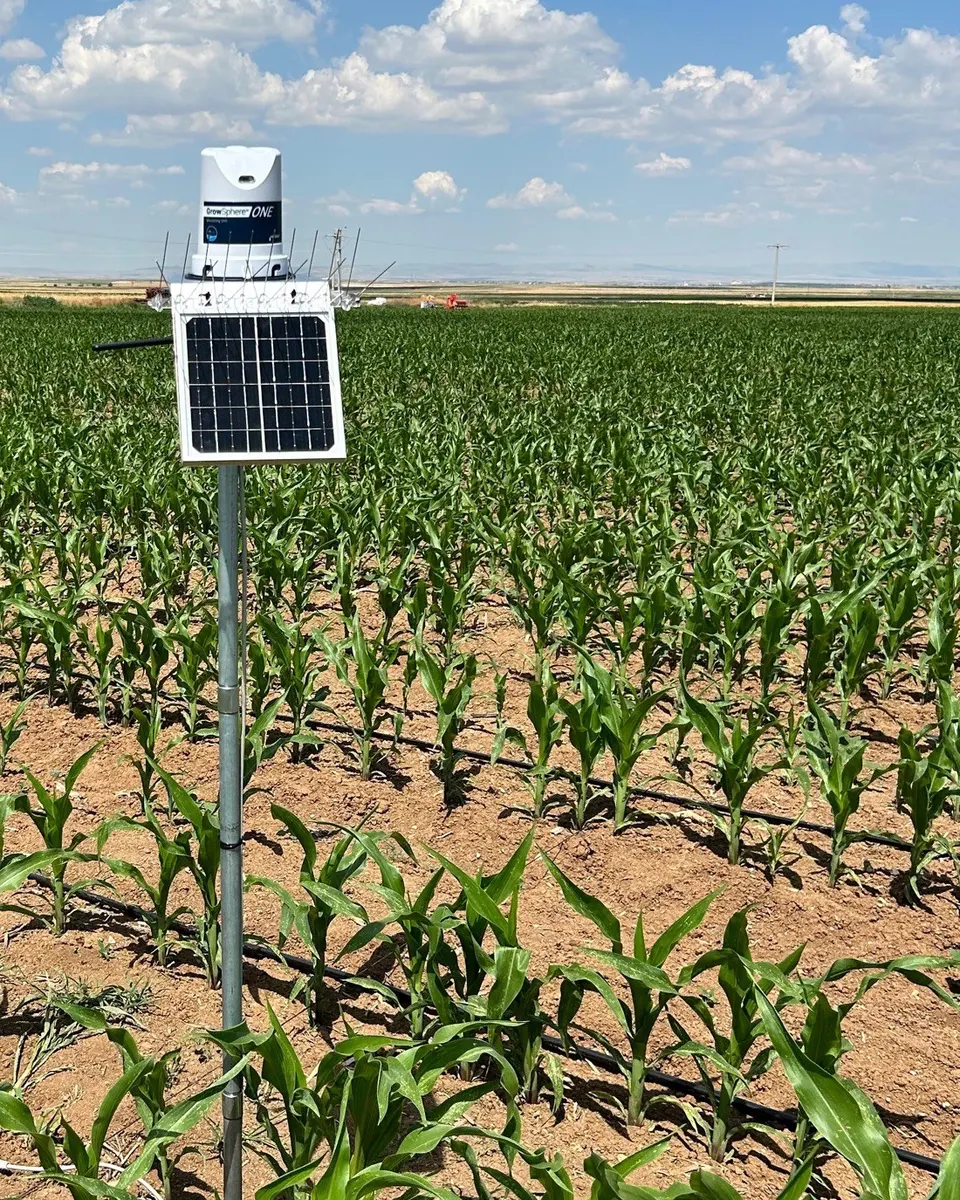
Field photographField observation of weather and environmental conditions using a GS-ONE station. Root-zone / soil-moisture observation
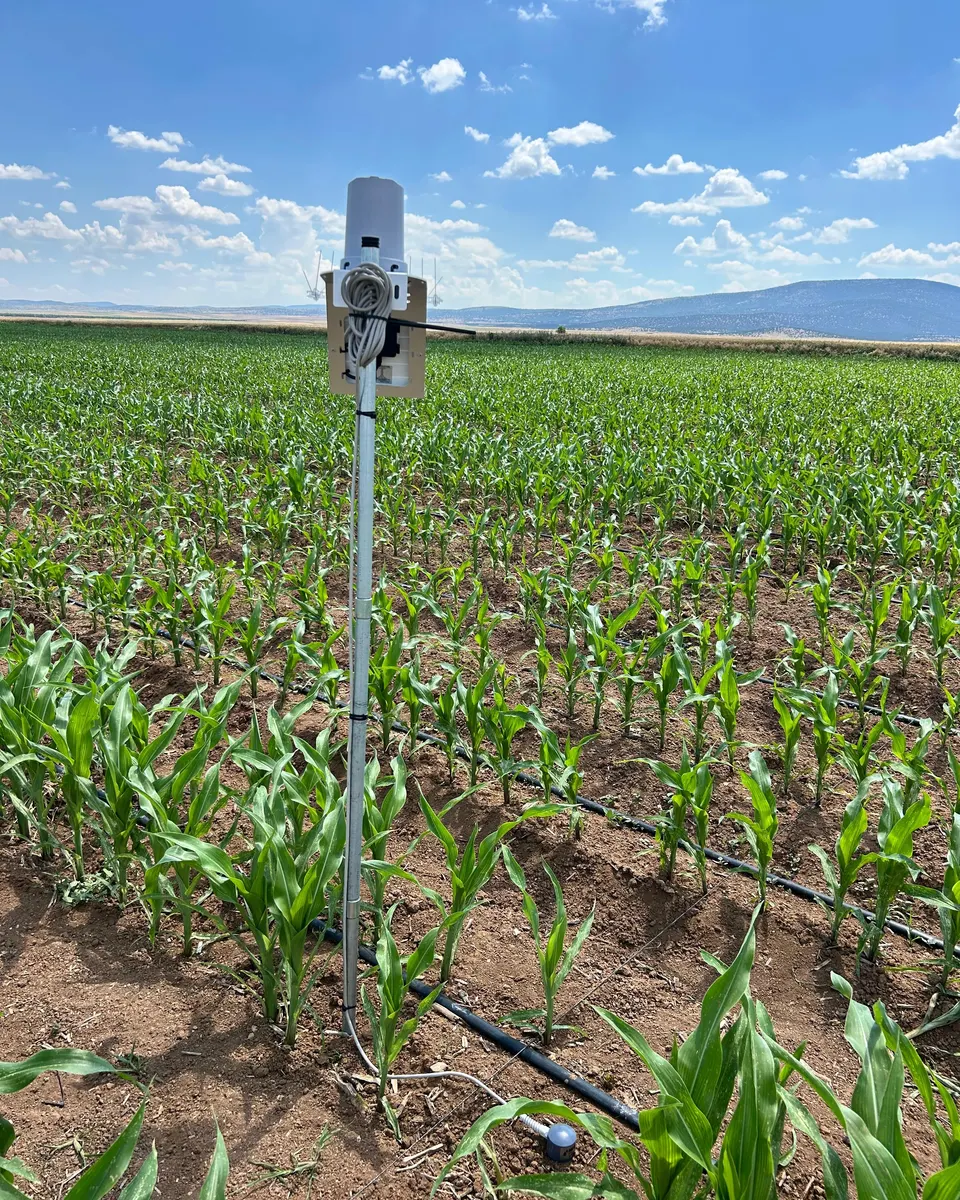
Field photographSoil-moisture monitoring station within the crop Operational control
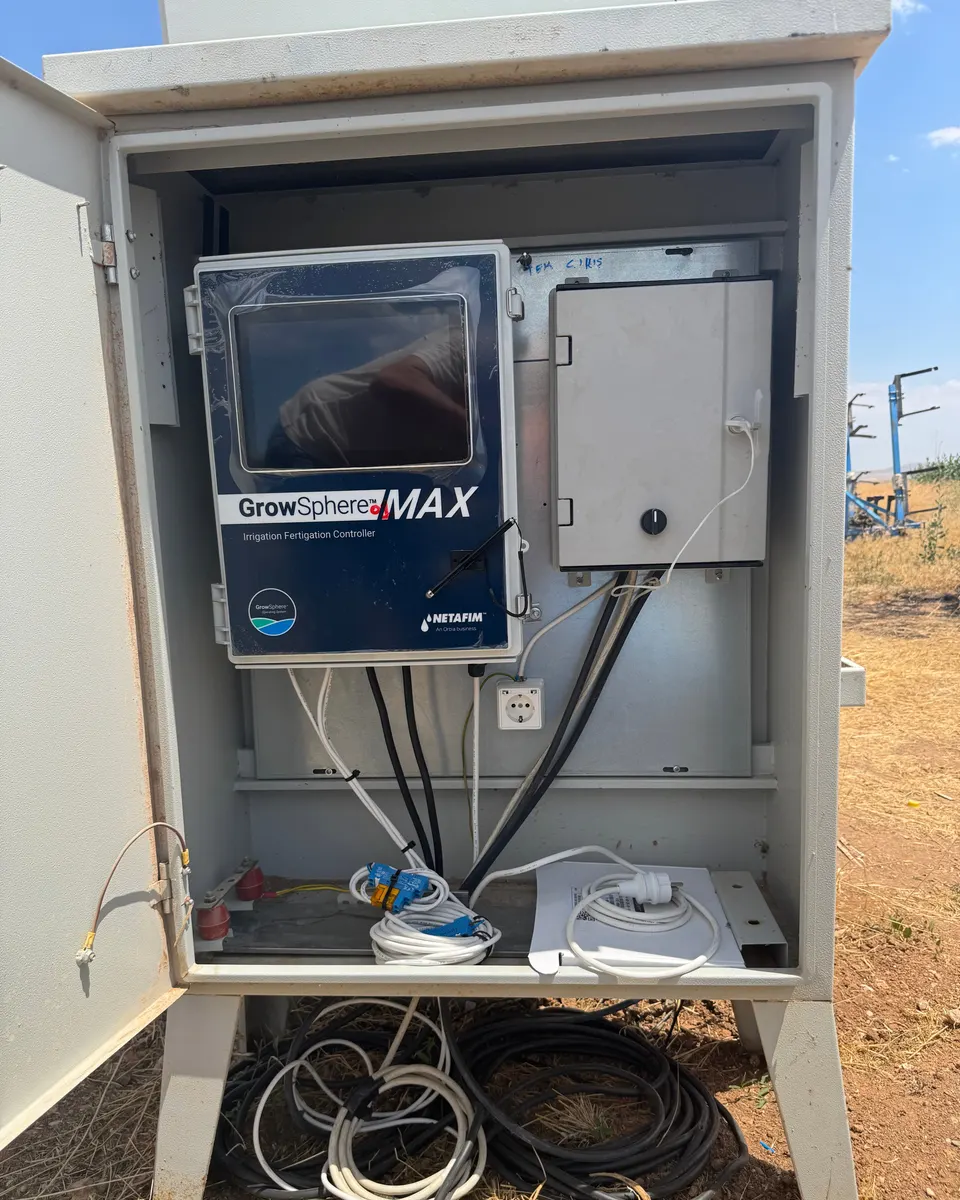
Field photographField irrigation and fertigation controller Hydraulic measurement
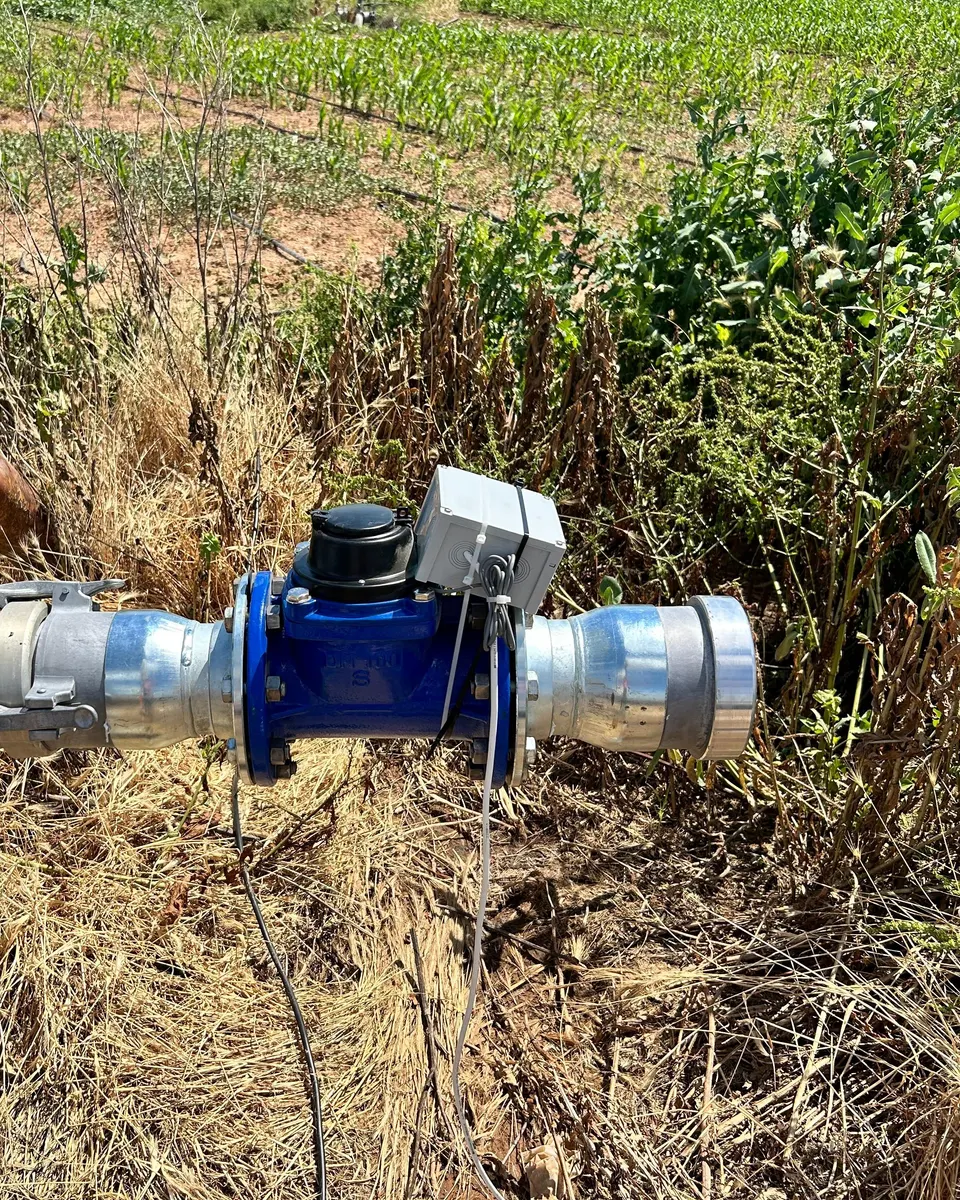
Field photographWater meter and valve on the main supply line
Engineering intelligence: what the system is capable of
The design basis of the installed infrastructure — hydraulic assumptions, block flow and pressure, filtration capacity, pump duty, fertigation capability, control logic. This is the layer most operations do not have, because the design is filed and forgotten after handover. Without it there is no reference to compare operation against, and every deviation has to be diagnosed from scratch. Maintaining engineering intelligence means keeping the design's intent available and current as the system is modified.
Operational intelligence: how the infrastructure is running
Flow, pressure, irrigation events and durations, filtration cycles, energy use, alarms and interventions — the operating record of the system as it runs. Its value depends almost entirely on data quality: intervals, gaps, sensor drift and unrecorded manual changes decide whether a record can be reasoned from at all. A large archive of unreliable readings is not an asset.
Decision intelligence: what actually needs deciding
Irrigation timing and volume, fertigation programme, maintenance priority, which block to investigate, whether to replace or repair, whether capacity is sufficient for next season's plan. Each of these has an owner, a frequency and an information requirement. Working backwards from the decision list to the measurements that serve it produces a much smaller and more useful measurement set than working forwards from what sensors can capture.
Engineering intent and observed behaviour
Data becomes useful at the point where it can be read against something. Engineering states what the installed system was designed to do; operation produces a record of what it is doing; the comparison between them is where a number turns into a finding. Without the design intent on file, every deviation has to be diagnosed from nothing, which is why the engineering layer matters more than the sensor count. This is a way of working, not a claim that AGIMEX holds verified performance records for past projects.
Performance intelligence: expected against actual
The comparison between what the system was designed to do and what it is doing. This requires both sides to exist: a recorded design expectation and a trustworthy operating record. Where they diverge, the honest first output is a question, not a diagnosis — a flow or pressure reading outside its expected range can follow from filter fouling, a valve position, a drop at the source or a failing sensor. Performance intelligence also feeds back into engineering: a system that consistently cannot meet its design assumptions has a design or installation problem, not an operating one.
What to measure, and where
Source flow and pressure, block-level flow and pressure, filtration differential, irrigation run times and root-zone moisture usually form the core set for an irrigated operation. Placement matters more than quantity: an instrument is worth installing where a reading narrows down which part of the system is behaving unexpectedly. Doubling the number of sensors without changing what is decided raises cost and lowers attention.
Working with the data an operation already has
Most controllers, pump panels and climate computers already log data or expose a standard output. The first question is what interval, completeness and reliability those existing records have, because that determines what can be concluded without spending anything. New instrumentation is proposed only where a specific decision cannot be supported by what already exists.
What this is and is not
This is engineering and agronomic decision support built around a defined decision set. It is not an autonomous system that makes agricultural decisions on its own, and AGIMEX does not present deployed predictive or automated decision systems as part of its project record. One implemented study was monitored and evaluated with operating data through a production season; no water, energy or yield saving is presented as a result of it. Agronomic judgement and operator review stay in the loop deliberately: the cost of a confidently wrong irrigation decision is paid by the crop.
Information to get started
- Operating questions to be answered
- Available data sources and sample records
- Decision owners and review frequency
Potential deliverables within the agreed scope
- Data and indicator definitions
- Monitoring and decision-support workflow
- Baseline and performance evaluation framework
These are examples, not limits. Deliverables depend on site assessment and the agreed scope of work, and a project may require engineering outputs not listed here.
Discuss a decision-support needFrequently asked questions
- Which decisions does agricultural data actually change?
- Irrigation timing and duration, the fertigation programme, maintenance priority and capacity planning. An indicator creates value only when it is tied to a question, an owner and an intervention that can be made; one without a counterpart is a maintenance cost.
- Which measurements are genuinely needed?
- First list the decisions the operation makes regularly, then ask what information each requires. Source flow, pressure, irrigation run times and root-zone moisture usually form the core set; adding sensors alone does not raise decision quality.
- Can data be taken from an existing system?
- Most controllers and pump panels either log data or expose a standard output. What matters first is at what interval and with what reliability the existing records were made; new hardware is proposed only after that gap is visible.
- Does a deviation mean a fault?
- No. A flow or pressure reading outside the expected range is a reason to investigate, not evidence of a particular fault. The same reading may follow from filter fouling, valve position, a drop at the source or a sensor problem.
Related engineering evidence
Seed-Maize Drip Irrigation, Fertigation and Automation
Implemented and commissioned — A seed-maize field with fertigated drip irrigation, block-level hydraulic control and soil-moisture monitoring, observed with operating data through one production season.
Irrigation Automation for a Large-Scale Orchard
Design completed — Engineering and design of measurement-backed irrigation automation for a multi-block orchard: programmed and remote valve control, water tracking through flow measurement and a water meter, soil moisture monitoring in reference blocks and fertigation control were set up as one system.
Multi-Zone and Expandable Irrigation Infrastructure
Design completed — AGIMEX design of an irrigation infrastructure for orchard, vegetable, pasture and landscape areas with two water sources, zone control and phased expansion.
Information moves through five layers: field intelligence carries what is physically happening, engineering intelligence what the installed system was designed to do, operational intelligence how the infrastructure is running, decision intelligence which decision needs evaluating, and performance intelligence the gap between expected and actual. The relationship between the engineering and operational layers is verification: it compares intended behaviour with observed behaviour and carries the difference into the decision layer. What performance shows feeds back into operation and design.
- Field intelligenceWhat is physically happening?
- Engineering intelligenceWhat was the system designed to do?
- Operational intelligenceHow is the infrastructure running?
- VerificationCompares engineering intelligence with operational intelligence, and carries the difference into decision.
- Decision intelligenceWhich decision needs evaluating?
- Performance intelligenceHow do expected and actual differ?
Performance intelligence → Operational intelligence / Engineering intelligence
These layers describe a capability architecture. They do not imply that every layer was deployed in past projects. Verification is not a separate layer or a product: it is the relationship between engineering intent and the behaviour observed in operation.
Explore our capabilities
Turnkey Agricultural Projects
For investors and agricultural operations, AGIMEX undertakes turnkey and integrated agricultural projects — turnkey greenhouse, orchard, irrigation and field irrigation projects — combining project development and engineering, procurement and supply, systems integration, installation, automation, testing and commissioning within one agreed scope. “Turnkey” describes that integrated delivery scope, not a fixed EPC or lump-sum contract model; responsibilities are defined in each contract.
Irrigation Engineering & Water Management
Irrigation design and engineering for commercial farms, orchards and greenhouses, and turnkey irrigation and field irrigation projects: AGIMEX carries crop-led hydraulic design and system specification and, within the agreed scope, procurement and supply, fertigation, automation, installation, testing and commissioning. AGIMEX does not manufacture irrigation equipment.
Greenhouse Projects
Greenhouse project design and engineering, and turnkey greenhouse projects, for growers and investors: AGIMEX connects crop strategy, structure, water, nutrients, climate and control in one design and, within the agreed scope, carries systems integration, procurement and supply, irrigation, fertigation, automation, installation, testing and commissioning. AGIMEX does not manufacture greenhouse structures; they come from qualified manufacturers.
Agribusiness Advisory
Agricultural feasibility studies, technical due diligence, project preparation and design review for agricultural investments — advisory grounded in production systems, technical feasibility and operating realities.